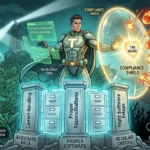
If you employ people in South Africa, you’re not just paying salaries. You’re also acting as a tax collector and contribution administrator for the state on behalf of your employees.
That’s where the three big acronyms come in:
- PAYE – Pay-As-You-Earn
- UIF – Unemployment Insurance Fund
- SDL – Skills Development Levy
Most small business owners know these letters from their payslips and EMP201 forms, but many don’t really know:
- What each one actually is
- Who pays what (employer vs employee)
- How they affect employees’ tax and benefits
- How they link into EMP201 (monthly) and EMP501 (annual reconciliation)
This guide breaks it all down in plain language, so you know exactly what you’re dealing with – and where mistakes can hurt you.
- Big Picture: Three Different Things, One Payslip
Let’s start simple.
When you run payroll, the three main statutory items you’ll see are:
- PAYE – your employee’s income tax, deducted from their salary and paid to SARS.
- UIF – a social insurance contribution for unemployment and related benefits.
- SDL – a levy paid by employers to fund skills development in South Africa.
Even though they often travel together on your EMP201, they’re not the same thing:
- PAYE and the employee part of UIF come out of the employee’s salary.
- SDL and the employer part of UIF are costs to the employer – they do not reduce the employee’s take-home pay.
As the employer, you:
- Calculate all three every month
- Deduct the employee portions from salaries
- Add the employer portions
- Declare and pay them to SARS on your EMP201 return
At year-end, you reconcile everything on your EMP501 (Employer Annual Declaration).
- PAYE – Pay-As-You-Earn (Employee’s Income Tax)
2.1 What is PAYE?
PAYE (Pay-As-You-Earn) is simply the income tax your employee owes, deducted monthly from their salary and paid over to SARS by you as the employer. Instead of your staff paying one big tax bill at the end of the year, tax is collected as they earn.
PAYE applies to most forms of remuneration:
- Basic salary and wages
- Overtime, commission, bonuses
- Certain allowances and fringe benefits (e.g. travel allowance, company car)
2.2 Who must register for PAYE?
You must register as an employer for PAYE with SARS if:
- You have employees who earn above the tax threshold, or
- SARS requires you to, based on your payroll.
Even small businesses and sole proprietors must register if they have employees above the threshold. PAYE isn’t “optional” once the legal conditions are met.
2.3 Who pays what?
- Employee – PAYE is their tax. It’s deducted from gross salary and reduces take-home pay.
- Employer – doesn’t pay PAYE out of pocket, but is legally responsible for:
- Calculating correct PAYE
- Deducting it
- Paying it to SARS on time
If PAYE is under-deducted or not paid over, SARS comes looking at the employer, not the employee.
2.4 How does PAYE affect employees’ tax?
Each month:
- PAYE is deducted and reported on the EMP201.
- At year-end, total PAYE deducted is shown on the employee’s IRP5.
When employees file their tax returns:
- The PAYE you deducted is credited against their total tax liability.
- If you over-deducted, they may get a refund.
- If you under-deducted (or didn’t report correctly), they may owe tax, and will usually blame you for “messing up” their tax.
PAYE is therefore the bridge between your monthly payroll and your employees’ personal tax returns.
- UIF – Unemployment Insurance Fund
3.1 What is UIF?
UIF is a statutory fund designed to provide short-term financial relief to workers who:
- Lose their jobs (due to retrenchment, dismissal, contract ending), or
- Can’t work temporarily (e.g. certain illness, maternity, adoption, etc.), and
- Meet the qualifying rules of the Unemployment Insurance Act.
It’s not “just another tax”; it’s more like a mandatory insurance policy for employees.
3.2 Who pays what?
UIF contributions are generally:
- 1% from the employee (deducted from salary), and
- 1% from the employer,
- Giving a total of 2% of UIF-liable remuneration, up to a monthly earnings ceiling.
So:
- Employee – has 1% of UIF-liable earnings deducted (reduces take-home pay).
- Employer – pays an extra 1% as a company cost (doesn’t appear as a deduction on the payslip).
You then declare and pay the total 2% to SARS on the EMP201, and the information ultimately feeds into UIF’s systems.
3.3 Which employees must contribute?
In general (with some exceptions):
- UIF must be paid for employees who work more than 24 hours per month for an employer.
Certain categories (e.g. some government employees or specific learners) may be excluded, but for most private-sector employees, UIF is compulsory.
3.4 How does UIF affect employees?
UIF:
- Reduces net pay slightly (the 1% employee portion), but
- Gives employees the right to claim UIF benefits if they lose their job or can’t work temporarily (subject to rules and contributions).
From a communication point of view, it’s helpful to explain on-boarding:
“You’ll see UIF on your payslip – that’s your contribution to the Unemployment Insurance Fund, which you may claim from if you lose your job or go on certain benefits.”
If you fail to deduct and pay UIF, employees may lose out on benefits, and you can be held liable for the arrears.
- SDL – Skills Development Levy
4.1 What is SDL?
SDL (Skills Development Levy) is a levy designed to fund skills development and training in South Africa. The money collected is channelled through the various SETAs (Sector Education and Training Authorities) to support workplace training and learnerships.
In short:
SDL is a way for government to fund training programmes using a small percentage of employer payroll.
4.2 Who must pay SDL?
SDL is generally payable if your total annual payroll exceeds R500,000.
- If your payroll is below this threshold, you usually don’t pay SDL.
- Once you cross this threshold, you must register and start paying.
4.3 Who pays what?
Unlike PAYE and UIF:
- SDL is 100% an employer cost.
- It is calculated as 1% of the total SDL-liable remuneration (effectively 1% of the payroll, subject to rules).
- It is not deducted from the employee’s salary; it’s an extra amount the employer pays to SARS.
So:
- Employees should not see SDL as a deduction reducing their net pay (if it appears on the payslip, it’s usually just for information).
- SDL affects the employer’s cost, not the employee’s take-home.
- How PAYE, UIF and SDL Show Up on the EMP201
Now that we’ve looked at each component, let’s bring them together.
5.1 What is the EMP201?
The EMP201 is your monthly employer declaration to SARS. On this single form, you declare how much you owe for:
- PAYE
- SDL
- UIF
- (And sometimes ETI – Employment Tax Incentive, if applicable)
It serves as both:
- A declaration of what you owe based on your payroll, and
- The payment instrument – you pay the total shown on the EMP201 to SARS, usually via eFiling.
The EMP201 must typically be submitted and paid by the 7th of the following month (or the last business day before if the 7th is a weekend/public holiday).
5.2 Quick example
Suppose you run payroll for the month and get:
- Total PAYE deducted from all employees: R35,000
- Total UIF:
- Employee portion: R1,500
- Employer portion: R1,500
- Total UIF to SARS: R3,000
- SDL (if applicable): R2,000
Your EMP201 for that month would show, for example:
- PAYE: R35,000
- UIF: R3,000
- SDL: R2,000
- Total due to SARS: R40,000
That total must be paid to SARS by the due date.
If you get these numbers wrong, the mistake will eventually show up when you do your EMP501 annual reconciliation.
- How Everything Links to the EMP501 (Annual Reconciliation)
Once a year, usually between 1 April and 31 May, you must file an EMP501 – the Employer Annual Declaration.
6.1 What is the EMP501?
The EMP501 is a year-end (and interim) reconciliation where SARS checks that:
- The PAYE, UIF and SDL you declared and paid each month on EMP201s
- Match the totals in your payroll system and the IRP5/IT3(a) certificates issued to employees.
Your EMP501 includes:
- All your EMP201 declarations for the year
- Information about payments made (excluding penalties/interest)
- Employee tax certificates (IRP5/IT3(a)) generated by your payroll
6.2 Why understanding PAYE, UIF and SDL matters for EMP501
If you don’t understand or manage PAYE, UIF and SDL properly during the year:
- Your EMP201 totals may not match your payroll totals.
- Your PAYE and UIF on IRP5s may not match what you actually paid to SARS.
- SDL may have been incorrectly applied or not applied when it should.
The EMP501 will then show mismatches, which can lead to:
- SARS queries and possible penalties/interest
- Problems for employees when SARS pre-populates their returns
- Time-consuming corrections and historic payroll adjustments
In other words:
Good control of PAYE, UIF and SDL month-by-month = smoother EMP501, fewer headaches.
- How These Deductions Affect Employees in Practice
From an employee’s perspective, these items affect:
- Their net pay (take-home)
- Their tax refund or liability at year-end
- Their access to UIF benefits
- Their confidence that the employer is compliant
7.1 On the payslip
A typical basic payslip might show:
- Gross salary
- Less: PAYE (their tax)
- Less: UIF (their 1% contribution)
- Plus/minus: other deductions/benefits
- = Net salary (what hits their bank)
SDL will normally not be shown as a deduction, because it’s an employer cost.
7.2 On the IRP5
The IRP5 summarises, for the tax year:
- Total taxable income
- Total PAYE deducted
- UIF contributions
- Other relevant amounts
SARS uses this to pre-populate the employee’s individual income tax return (ITR12). If your PAYE and UIF handling has been wrong, the employee’s tax return becomes a problem – and usually, you’re the first person they call.
7.3 On UIF claims
If staff lose their job or go on certain benefits, they may claim from UIF.
If you:
- Didn’t deduct or pay UIF correctly, or
- Didn’t declare them properly,
…their benefit may be delayed, reduced, or declined – leading to serious frustration and potential disputes.
- Common Misconceptions (In Plain Language)
Let’s clear up a few myths you might hear from clients or employees.
“It’s all just tax.”
Not quite:
- PAYE – yes, that’s tax.
- UIF – social insurance for employees, not income tax.
- SDL – an employer levy to fund training; employees don’t pay it.
“We’re a small business, we don’t need to worry about this.”
If you have employees and meet the criteria (e.g. salaries above the threshold, payroll above R500k for SDL, employees >24 hours a month for UIF), you must register and comply. Size doesn’t exempt you.
“We’ll just fix it at year-end.”
Leaving PAYE, UIF or SDL issues until EMP501 time is expensive and stressful. You may need:
- Back-pay corrections
- Revised EMP201s
- Extra payments plus penalties/interest
The smarter approach is monthly reconciliation and good record-keeping.
- Practical Checklist for Employers
Here’s a quick checklist to keep PAYE, UIF and SDL under control:
- ✅ I’m registered with SARS for PAYE, and UIF, and (if over R500k payroll) SDL.
- ✅ My payroll system correctly calculates PAYE using current tax tables.
- ✅ UIF is calculated at 1% employee + 1% employer (where applicable).
- ✅ If I’m liable for SDL, it’s correctly set at 1% of my payroll.
- ✅ I submit and pay my EMP201 on or before the deadline each month.
- ✅ I reconcile payroll totals to EMP201 totals every month.
- ✅ I understand that at year-end, the EMP501 must reconcile PAYE, UIF and SDL across payroll, EMP201s, and IRP5s.
- ✅ Employees receive clear payslips and IRP5s, and I can explain the deductions if asked.
If you can confidently tick all of these, you’re on a solid path.
- Final Thought: Get the Basics Right and Everything Else Becomes Easier
PAYE, UIF and SDL might look like “small lines” on a payslip, but they carry big responsibilities.
When you understand:
- What each one is,
- Who pays what,
- How they affect employees’ tax and benefits, and
- How they feed into EMP201 and EMP501,
…you’re far less likely to run into trouble with SARS or with your staff.
Whether you manage it in-house or outsource to a specialist, the goal is the same:
Accurate, compliant payroll every month = fewer surprises, smoother reconciliations, and happier employees.